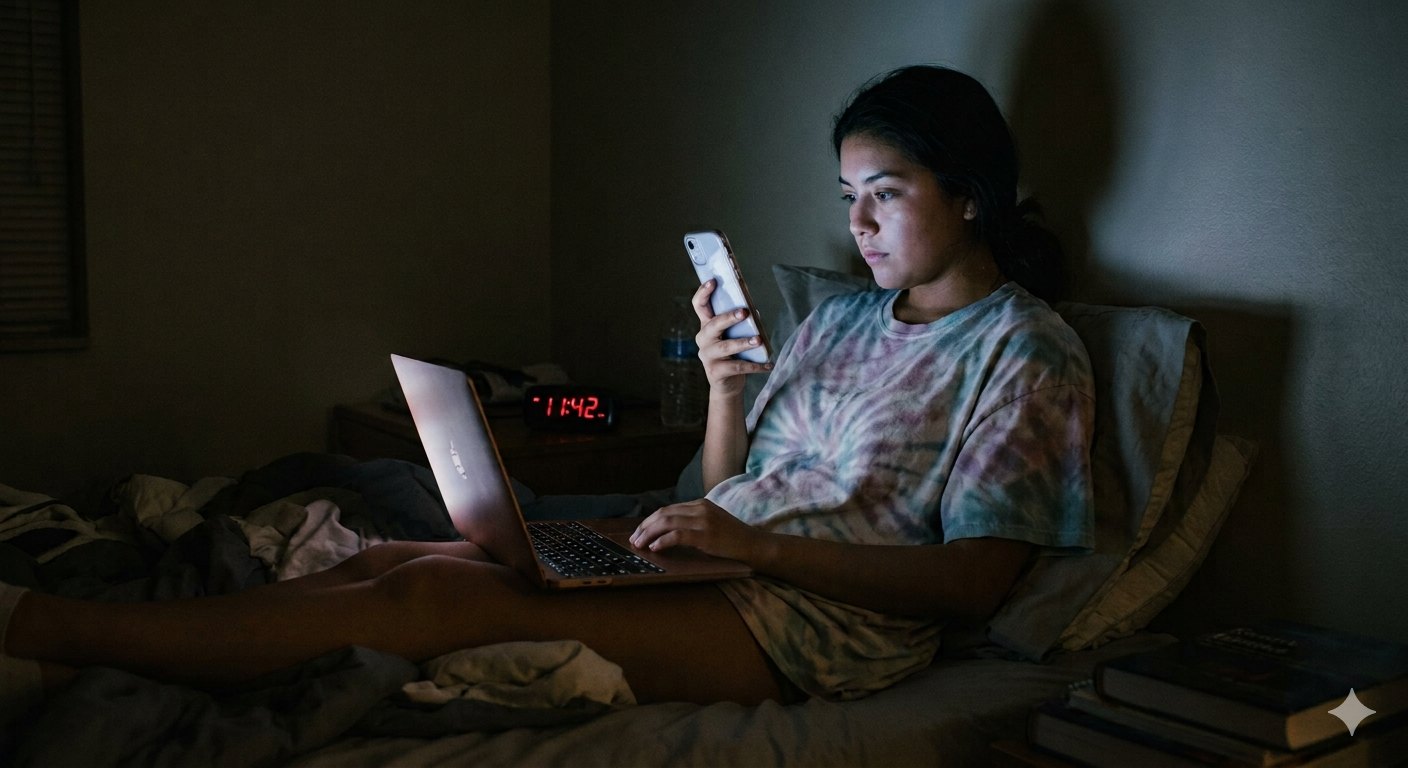
Cinderblock walls that hold heat. A roommate on a different schedule. A hallway that never fully goes quiet. An 8AM Tuesday they didn’t choose and a lab that runs until 9PM on Wednesday. A library selling cold brew until midnight. A dining hall that closes early.
None of that is a character flaw. It’s an environment — and it’s the same environment at every school in the country. The student didn’t fail at sleeping. They were placed inside a machine that’s very good at preventing it, and nobody taught them how best to adapt.
In the largest study of its kind, roughly three quarters of students said they had never received any information about sleep from their university — and researchers were still calling campuses an “underutilized” venue for sleep education in 2025. Hartmann & Prichard, Sleep Health, 2018 (n=55,322); Howlin et al., Sleep Medicine: X, 2025
It isn’t on the campus tour. It isn’t in the orientation packet. There’s no line item for it, no ranking of it, no consultant who specializes in it. Nobody tells parents it matters, so nobody thinks to ask.
Sleep matters — it affects their grades, their happiness, and their ability to socialize: Sleeping badly five nights a week is associated with a GPA about a tenth of a point lower — a 3.6 that’s a 3.5. Sleep-deprived people are measurably harder to be around, and the people around them come away lonelier.
Read the research →Google "college sleep" and you get thousands of links to blogs and research papers.
None of it is wrong. The mechanisms are real and the research solid.
The student will do none of it because the information isn’t accessible or packaged in a way that will help them learn how to get better sleep at school.
Why standard sleep advice fails →I know this one from the inside, because I built one.
We had a finished formula. Four ingredients, each chosen against a rule we wrote down before we started looking: find human randomized trials, on the exact outcome, in stressed adults, at a matching dose — and only then ask about mechanism. That rule eliminated most of the shelf.
Then we looked at the research and realized that it doesn’t support the marketing claims.
That’s not an outlier. That’s the category. Almost nobody funds sleep supplement research except the people selling sleep supplements.
So we killed it. Not because the formula was bad — it was defensible, and better than most of what’s on the shelf. We killed it because the best case for that capsule was a few extra minutes, and a student who understands what’s actually costing her sleep can do considerably better than that.
What we found on the shelf →A few schools do run one, and if the student’s school does, start there. Most are licensed to the university and can’t be bought by individuals. Here’s a breakdown of the college sleep program options.
She graduated this spring.
She slept badly her freshman and sophomore years. Not dramatically — no crisis, no diagnosis — just two years of college being harder than they had to be, during a time that was supposed to be the best time of her life. I paid for every one of those years and never once thought about it.
Then she learned one thing about caffeine. Not a routine. One fact, one time.
And her sleep improved — not because she was disciplined about it, but because she couldn’t un-know that her Diet Coke at 10pm was affecting her sleep. The fact just sat there, every night, at 10pm, in front of the vending machine. It didn’t require willpower. It made the thing less appealing.
That’s one kid, and one kid is not evidence. But it’s the reason this exists, and it’s the whole thesis in one story: she didn’t change her behavior. She changed what she knew, and the behavior followed.
They’ve heard the advice — get more sleep, put the phone down, don’t drink coffee late. It’s the same list everyone’s heard, and it rarely survives week two of a semester. A rule you’ve been handed is only as strong as the willpower behind it.
What actually changes behavior is understanding. When a student learns that the energy drink they had at 5 PM is still working in their body at midnight, they don’t need discipline to skip it next time — it just stops being appealing. That’s what happened with our own daughter after two years of bad sleep. She didn’t decide to change her habits. She learned one thing she couldn’t un-know, and her habit changed.
That’s what College Wrecks Your Sleep built the College Sleep Hacks™ on — an online sleep program for college students. Twenty-five specific, doable changes — a cutoff time, a wake time, a way to cool a room you don’t control, a conversation with a roommate — each paired with the research that explains why it works — 74 peer-reviewed studies, including systematic reviews drawing on more than 60 randomized controlled trials. Delivered by text on their own schedule, one at a time, so each one has room to land.
These sleep hacks become habits the student chooses, not rules they were handed. Habits that help them get better sleep at school.
Our College Sleep Hacks address what college does to a student’s sleep — the building, the schedule, the caffeine, the roommate on the opposite clock. For most students that is what’s wrong, and it is fixable without a prescription (or sleep supplements).
Some sleep problems are not that.
If the student snores loudly and wakes up gasping, or is exhausted through the day after a full night in bed, that might be sleep apnea. If their legs feel crawling or restless in the evening and moving them is the only thing that helps, it could be restless legs syndrome. If they have been unable to fall asleep or stay asleep most nights for months, it could be chronic insomnia.
Any of these is worth a conversation with a doctor, and none of them is what our Sleep Hacks are for. Chronic insomnia in particular has its own first-line treatment — CBT-I — which this program is not.
No subscription. Nothing else to buy.
Buy NowFor students 18 and older.
You receive a registration code after purchase to send to the student.
See our 60 Day Refund Policy.