My daughter is the reason this exists.
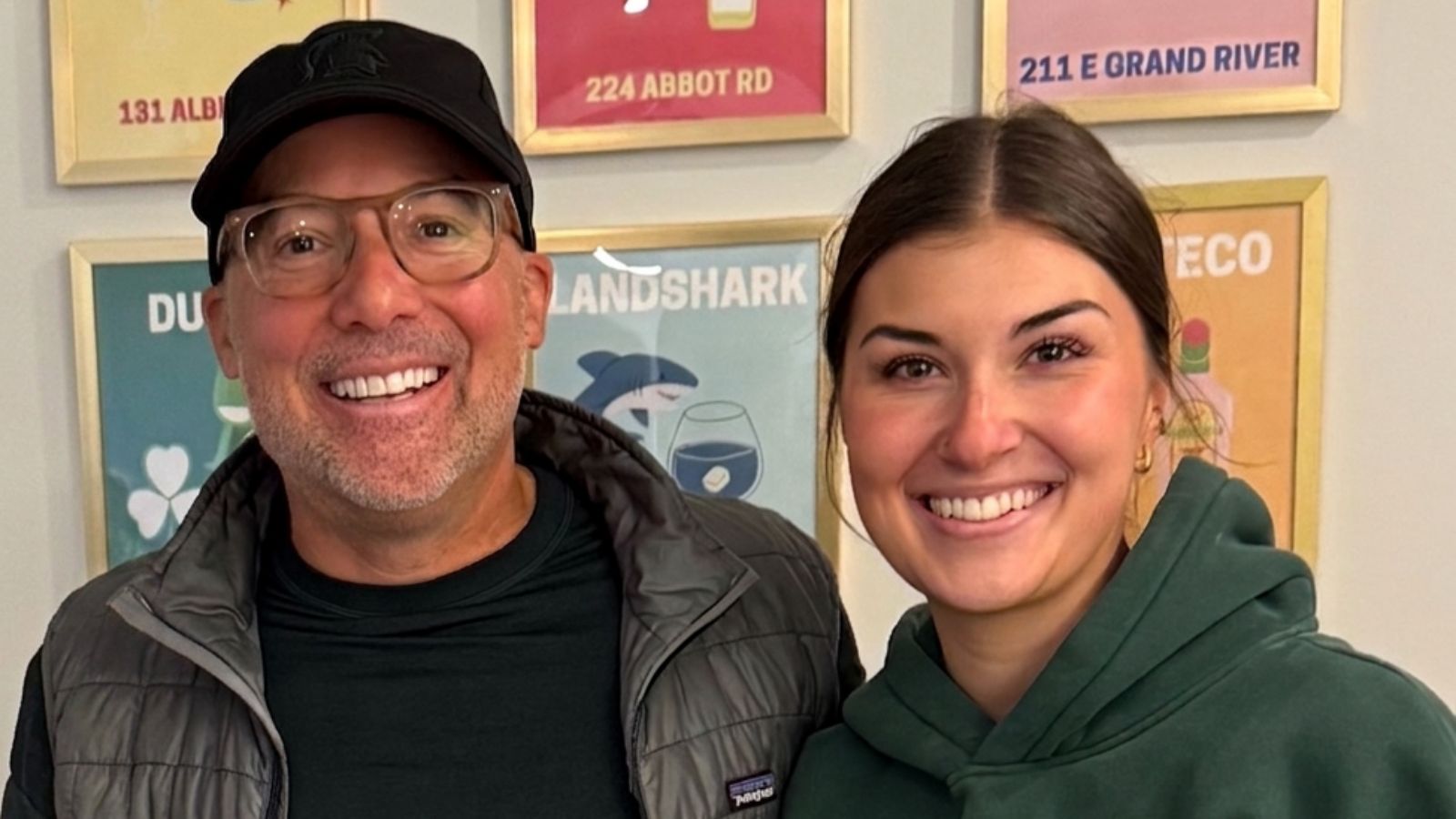
I’m Dave and this is my daughter Ellie. I got interested in sleep and college students four years ago after watching Ellie sleep badly her freshman and sophomore years. Not dramatically — no crisis, no diagnosis — just two years of college being harder than they had to be, during a time that was supposed to be the best time of her life.
Then she learned one thing about caffeine. Not a routine. One fact, one time.
And her sleep improved — not because she was disciplined about it, but because she couldn’t un-know that her Diet Coke at 10pm was affecting her sleep. The fact just sat there, every night, at 10pm, in front of the vending machine. It didn’t require willpower. It made the thing less appealing.
That’s one kid, and one kid is not evidence. But it’s the reason this exists, and it’s the whole thesis in one story: she didn’t change her behavior. She changed what she knew, and the behavior followed.
That thesis is why College Wrecks Your Sleep exists, and why we built the College Sleep Hacks™ — an online sleep program for college students: 25 Sleep Hacks that provide information, then advice, so students can decide what changes work best for them.
The obvious solution was a sleep supplement.
It’s the obvious solution because it’s a good business model students see ads for every day. Recurring revenue. High margin. A category where “supports restful sleep” is a legal sentence you can print on a box without proving much of anything. I’ve worked in supplements. I know exactly how that company gets built.
We killed it, because the evidence didn’t hold up. The largest meta-analysis on melatonin finds it shortens time to fall asleep by roughly seven minutes.1 Seven minutes. That’s the flagship ingredient in a category worth billions, and the honest version of the label would have to say so.
The famous “magnesium deepens sleep” finding is twelve people, for two weeks, in a study its own reviewers say “cannot be applied to an adult population.”2
I didn’t want to spend the next ten years selling college students a thing I wouldn’t give my own kid. So we built the other thing — the part that actually worked on Ellie.
Information first, then advice.
Advice on its own tells a student what to do and then depends on them wanting to keep doing it every night for four years. That’s a maintenance problem, and maintenance is where almost everything in this category quietly fails.
The 25 hacks are more than just tips. Each one is a short, interactive page — five to seven minutes — that explains one specific mechanism about sleep in a dorm, shows the student where they personally land on it, cites the research underneath it, and then gives them one realistic thing to do. Caffeine’s half-life and what a 4PM cold brew is still doing at midnight. What alcohol actually does to the back half of the night. Why the room temperature matters more than the mattress.
The bet is that a student who understands why the 4PM cold brew is the problem doesn’t need to be reminded to skip it. That’s not a claim I can prove at scale yet. It’s what happened to Ellie, and it’s the reason I built this instead of the supplement.
Four things I decided up front.
It’s the student’s, not yours.
You buy it and send a code. They set up their own account with their own email and their own phone number. You don’t get their answers, their progress, or a report at the end — they have the option to tell you when they finish, and that’s their call. A program a student controls is one they’ll actually open.
No subscriptions.
$99 once. No subscription, no renewal, no upsell, no second product waiting at hack 25. Twenty-five hacks and then it’s over, and they keep everything.
Every sleep hack is backed by science.
Not by my opinion, and not by what’s trending. The hacks cite 74 peer-reviewed studies, including systematic reviews drawing on more than 60 randomized controlled trials — from labs at Harvard, MIT, UC Berkeley and Carnegie Mellon, alongside work from Michigan, Pittsburgh, Stanford and others, published in journals including Nature, Nature Communications, Sleep Health and the Journal of Political Economy.
Every hack ends with its sources: authors, journal, year, sample size, study design. Where the research is weak, the hack says so. Where a result comes from an industry-funded study, the hack says that too. And where something is a correlation rather than a cause, we use the word “associated” and explain the difference — because that distinction is doing a lot of quiet work in this category, and almost nobody selling into it bothers to make it.
We cite published research from these institutions. We are not affiliated with, endorsed by, or sponsored by any of them.
We don’t sell your data.
Not to schools, not to advertisers, not to anyone. See the Privacy Policy and the Consumer Health Data Policy for the specifics.
Thank you for reading this far. If you have questions or want to get in touch, reach out to me at dave@collegewrecksyoursleep.com.
Dave KnoepfleFounder, College Wrecks Your Sleep and The College Sleep Score
See a Sleep Hack in action
Caffeine and Sleep is one of our top-rated Sleep Hacks. It’s free and requires nothing — no email, no account. It’s exactly what the other twenty-four look like.
Online Sleep Program
No subscription. Nothing else to buy.
Buy NowFor students 18 and older.
You receive a registration code after purchase to send to the student.
See our 60 Day Refund Policy.
- Ferracioli-Oda, E., Qawasmi, A. & Bloch, M.H. (2013). Meta-analysis: melatonin for the treatment of primary sleep disorders. PLOS One, 8(5), e63773. Pooling 19 studies and 1,683 subjects, melatonin reduced time to fall asleep by 7.06 minutes (95% CI 4.37–9.75) and increased total sleep time by 8.25 minutes. The authors describe the effects as modest, and smaller than those of prescription sleep medications.
- Held, K., Antonijevic, I.A., Kunzel, H., et al. (2002). Oral Mg2+ supplementation reverses age-related neuroendocrine and sleep EEG changes in humans. Pharmacopsychiatry, 35(4), 135–143 — the twelve-subject, two-week trial behind the slow-wave-sleep claim. The quoted assessment is from Arab, A., Rafie, N., Amani, R. & Shirani, F. (2023). The role of magnesium in sleep health: a systematic review of available literature. Biological Trace Element Research, 201(1), 121–128, which reviewed it and reported that a study of fewer than 20 subjects “is unlikely to be sufficient for investigation” and that the results “cannot be applied to an adult population.” See also Mah, J. & Pitre, T. (2021), BMC Complementary Medicine and Therapies, 21(1), 125, which rates the magnesium evidence base “low to very low.”