
University Dorm Temperature Policies Are Set Too Warm for Sleep
Published August 24, 2026
Key takeaways
- We analyzed the published temperature policies at 21 US universities. Heating targets clustered at 68–72°F; where cooling exists, targets ran higher, generally 72–76°F.
- The range generally described as supporting sleep is 60–67°F. Every published target we found sits above it, with one exception — UW–Stout, which lets students set 60–72°F.
- Not one of the 21 policies mentions sleep, night, or overnight temperature. Every one frames its target around comfort, occupancy or energy use.
- At some universities three to five neighboring rooms share one system, which follows whatever the majority is asking for. A student who wants a cooler room at midnight is outvoted by neighbors sitting at desks.
- Many students cannot adjust the temperature at all — no thermostat in the room, or none in the hall. At one university in our sample, no residence hall has air conditioning.
- Two-pipe systems heat or cool, but not both in the same season. That switchover gap is why dorms are so hot in September — exactly when a first-year is trying to establish a sleep schedule.
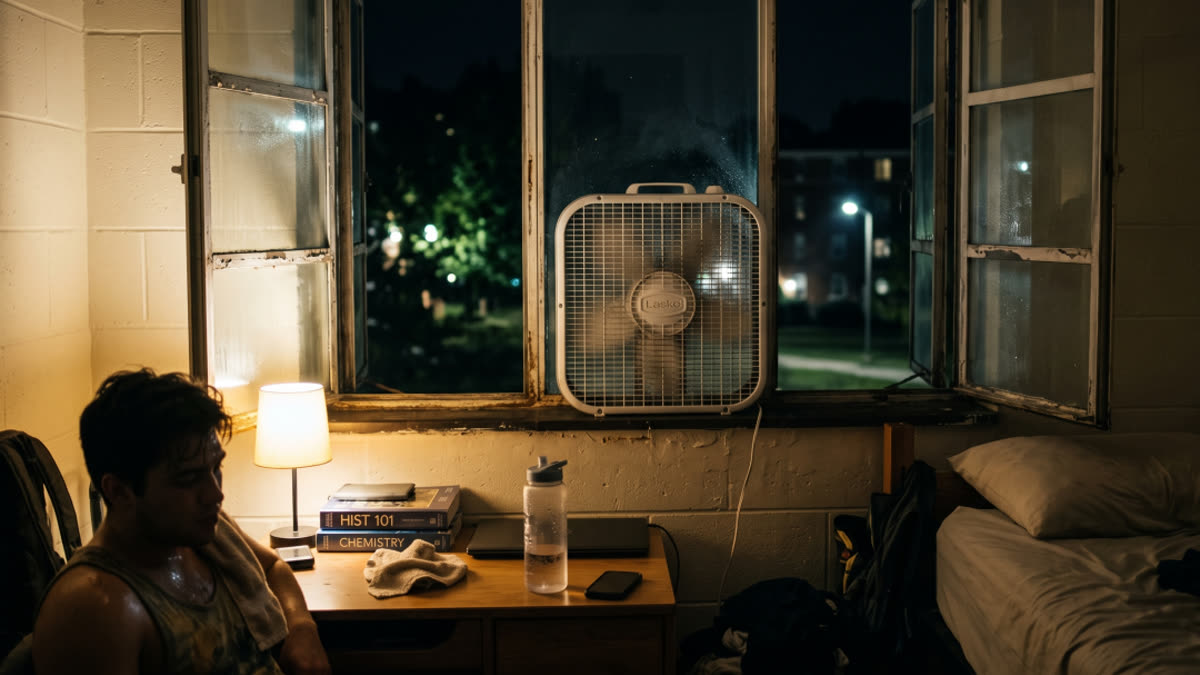
Why is my dorm room so hot? is one of the most common complaints of a first semester — and it is the one sleep problem a student cannot solve with willpower. You can change when you go to bed. You cannot decide your way out of a building’s HVAC settings.
There is no national dataset on US dorm room temperatures, so we collected and analyzed what 21 universities publish about their own. Most set heating to somewhere between 68 and 72°F. The policies turned out to be more specific than we expected — and every one of them was written for a student who is awake.
Why we looked
The academic literature on student housing thermal comfort exists, but it is almost entirely from outside the United States — different climates, different building stock, different assumptions about air conditioning. None of it tells you what a residence hall in Syracuse is set to in February.
What does exist is public. Universities publish their own temperature policies, and a published policy has a useful property: it is what the building is set to, not what someone remembers it feeling like. So we gathered all 21 and analyzed them against the range the research supports.
What temperature are dorm rooms set to? What the policies say
Reviewed Dorm Temperature Policies
Finding 1: every dorm temperature policy we found but one sits above the range that supports sleep
Falling asleep depends on core body temperature dropping. Heat exposure works directly against it: a review in the Journal of Physiological Anthropology found that a warm sleeping environment raises wakefulness and reduces both slow-wave and REM sleep, and that the core-temperature decline is tied to sleep onset itself. As noted above, the room temperature that supports sleep is roughly 60 to 67°F.
Worth being precise about what those two sentences are. The direction is a research finding: cool helps, warm hurts, and the mechanism is understood. The range is a consensus recommendation rather than the output of a trial — no study has established that 67°F is a threshold and 68°F is not. We use it here because it is the figure the field generally works from, and because the gap we found is wide enough that a degree or two either way does not change it.
Here is every published heating setpoint we found, sorted:
68°F — Syracuse, Columbia, Liberty, Bowling Green, UC Merced, Swarthmore, CU Boulder, Arkansas, George Mason, Michigan State · 70°F — Harvard Law, Binghamton, Houston, Maryland
The lowest number on that list is 68°F. Not one setpoint falls inside the range, and the cooling targets — which govern a student’s room in August and September — sit higher still, between 72 and 76°F. Whatever the precise ceiling turns out to be, every setpoint we found is on the warm side of it.
The University of Iowa goes further and rules it out explicitly. Every hall there is air conditioned and students set their own thermostat, but the policy instructs them: “Do NOT set your thermostat lower than 68 degrees. Setting temps lower may not allow for proper de-humidification and may cause other issues.” The reasoning is sound building science — running a system too cold can leave humidity uncontrolled. The effect, though, is that the coolest room a student at Iowa is permitted to create is 68°F, one degree above the top of the range. Everywhere else in this sample the gap is incidental, a setpoint chosen for daytime comfort that happens to land too warm. Iowa is the only policy we read that states the boundary as a rule.
The single exception in our sample is UW–Stout, which tells residents their thermostat controls the room “between 60 and 72 degrees in the winter” — the only published range we found that reaches into sleep territory, and one of the few that hands the decision to the student.
Finding 2: none of them mentions sleep
Across all 21 policies, we found no reference to sleep, to night, or to overnight temperature. Every policy frames its target around one of three things: comfort, occupancy, or energy use.
The language is consistent and revealing. Swarthmore aims for its range “during regular work hours.” Columbia specifies “normal occupied hours.” Michigan State’s policy describes “a comfortable working and learning environment.” The University of Houston’s setpoint table divides the day into occupied, unoccupied, and setback hours.
Penn State’s energy policy covers all university facilities and allows temperatures during “low occupancy or unoccupied periods” to fall to 60°F in winter and rise to 85°F in summer — the widest published range in our sample.
Columbia goes further and names the standard behind the number: ASHRAE Standard 55, Thermal Environmental Conditions for Human Occupancy. It is a good standard. It is also, by its own title and design, written for people who are awake, upright and dressed for the season.
None of this is a scandal. Managing temperature across thousands of rooms in buildings of wildly different ages is genuinely hard, and every policy we read was making an honest trade between comfort and energy. The observation is narrower than a criticism: a residence hall is the one building on campus where the primary activity is sleeping, and it is governed by a framework written for offices.
Finding 3: at some schools, the temperature is decided by majority vote
This was the most surprising thing we read, and it comes from a Big Ten university’s own residential facilities guidance:
Three to five rooms, one vote
“Three to five neighboring rooms share the same heating and AC system housed in the ceiling. If some rooms are set to ‘heat’ and others to ‘cool,’ the system will go with what most rooms are asking for.”
Source: residential facilities guidance, Big Ten university, reviewed August 2026.
Read that again with a sleeping student in mind. A student who wants a cooler room at midnight is not negotiating with their roommate. They are in an election with three to five neighbors — most of whom, at any hour when anyone is adjusting a thermostat, are awake, sitting still at a desk, and voting for warmth.
A Big 12 university describes a similar arrangement in its older halls, with an additional twist: “multiple units will be attached to one temperature control, meaning that one room will control the temperature of a few other rooms around it… If you find your room getting too warm, one of your neighbors may have a window open, signaling to the thermostat that the rooms are colder than they are.”
So a stranger’s open window can make your room hotter, and you will never know why.
Finding 4: many students have no dorm temperature control at all
George Mason states plainly that “many of our first-year residence halls are built with central air units that do not allow students to adjust the temperature in their spaces.” Harvard Law’s Gropius Complex is controlled by building sensors, and “resident rooms are not equipped with individual thermostats.” SUNY Cortland notes that in some buildings there is a single thermostat for an entire floor or section.
Air conditioning is not universal either. Most CU Boulder residence halls have none. Several Harvard Law halls have none. SUNY Cortland describes older halls with no cooling or “very limited cooling.” At Portland State no residence hall has air conditioning, and the housing handbook does not permit window units. The University of Iowa stands out for the opposite reason — every hall is air conditioned.
One institution in our sample gives students a genuinely cool option. UW–Stout tells residents their thermostat will control the room “between 60 and 72 degrees in the winter.” That 60°F floor was the lowest published figure we found anywhere — though in the same document, North Hall residents are told that while they cannot control the temperature of their room, they can adjust the fan speed.
Finding 5: the switchover gap explains why dorms are so hot in September
Many residence halls run two-pipe systems that can deliver heating or cooling, but not both in the same season. Switching between them is a scheduled event, not a thermostat setting.
The University of Arkansas puts it bluntly: “we essentially only get one chance to turn ON/OFF the air/heat.” Western Illinois publishes the actual trigger conditions — air conditioning goes on only when there are at least three consecutive days of 80°F or higher, with overnight lows not dropping below 50°F. The University of Iowa turns on steam by around October 15. George Mason switches in mid-October.
UW–Madison publishes the reverse trigger for spring: heat stays on until daytime temperatures are “consistently above 60 degrees” and overnight lows above freezing, which usually lands in mid-April.
What that looks like from inside a room was documented by student journalists at the University of Pennsylvania in 2024. The campus switched from cooling to heating on October 22; unusually warm weather continued into November with outside temperatures occasionally above 80°F. Students reported their rooms were too warm to be comfortable in. The Daily Pennsylvanian noted the same complaints had been made after the 2021 switchover.
Which means there is a stretch every autumn when the outside is warm, the cooling equipment is off or already switched over, and nothing can be done about it from inside the room. That stretch overlaps almost exactly with move-in and the first month of the semester — the period when a first-year student is trying to establish a sleep schedule in an unfamiliar bed.
What nobody tells college students about sleep
College Wrecks Your Sleep developed the College Sleep Hacks™ — 25 Sleep Hacks based on peer-reviewed research to help students get better sleep at school. We deliver our Sleep Hacks via text or email, at a flexible pace designed for optimal learning. $99 buys lifetime access to our Sleep Hacks, Sleep Tools, and Sleep Resources.
How we did this, and what it isn’t
We searched for publicly posted temperature, heating and cooling policies from US universities and recorded what each one stated for residence halls. We included every institution we found with a published figure or a substantive published policy. Where a university publishes different rules for different buildings, we recorded the range.
Four limitations worth stating plainly.
This is a convenience sample, not a random one. It is biased toward institutions that publish their policies at all, which likely skews toward larger and better-resourced schools. A proper survey would sample randomly from a national list.
These are policies, not measurements. A stated setpoint is a target. Several of the policies we read openly acknowledge that actual room temperature varies with building age, floor, sun exposure and how well the windows seal. Nobody has published measured overnight temperatures across US residence halls, and somebody should.
The sleep-temperature range is a recommendation, not a measurement. The mechanism is well established and cited above. The specific 60–67°F figure is a consensus number that the field converges on rather than a trial result, and we have said so where it appears. Our finding is that every published setpoint sits above it — not that a specific degree marks a threshold.
Twenty-one is a small number. There are more than 3,000 four-year institutions in the United States. This tells you what a handful of them publish, not what the country does.
How to cool down a dorm room you don’t control
Less than they would like, and more than they think.
The building is not adjustable, but the space immediately around a sleeping body partly is — airflow, bedding, what happens to skin temperature in the hour before bed, and how heat leaves the room once the sun is down. Those are the levers that remain when the thermostat is either shared, absent, or set for someone at a desk.
This is exactly the problem Sleep Hack 03 was written for. It is the hack in the College Sleep Hacks™ that deals with the dorm you cannot cool — what to do when the room is set for somebody at a desk and the thermostat is shared, automated, or missing entirely. It does not ask a student to change the building. It works on the one thing they still control, which is what happens to their own body temperature in the hour before they get into bed.
The wider point is the one worth taking from all of this. A student lying awake in a warm room at 1am is not failing at sleep. They are living inside a system that was optimized, reasonably and in good faith, for a different activity entirely — and nobody ever told them that.
Frequently asked questions
Is this a criticism of universities?
No. Managing temperature across thousands of rooms in buildings of very different ages is genuinely difficult, and every policy we read was trying to balance comfort against energy use honestly. The observation is narrower: the frameworks these policies rely on were written for occupied daytime spaces, and a residence hall is the one building on campus where the primary activity is sleeping.
Is there a fix for a dorm room you cannot cool?
Partly. You cannot change the setpoint, the switchover date, or a thermostat shared with four other rooms. What remains under a student’s control is what happens to their own body temperature in the hour before bed, plus airflow and how heat leaves the room after dark. Sleep Hack 03 in the College Sleep Hacks™ covers this specific situation — the dorm you cannot cool — and works on the levers a student still has rather than the ones they don’t.
Why is my student’s dorm room so hot?
Three reasons, usually. The setpoint is chosen for daytime comfort rather than sleep. Many halls run systems that can heat or cool but not both in the same season, so during the warm weeks at the start of term the cooling equipment may not be running at all. And in a number of buildings the student cannot adjust the temperature themselves, because the thermostat is shared, automated, or absent.
What temperature are college dorms actually set to?
Across the 21 US institutions whose published policies we reviewed, heating targets clustered between 68 and 72 degrees Fahrenheit. Where cooling exists, targets ran higher, generally 72 to 76 degrees. Several institutions publish no residence hall figure at all, and Michigan State explicitly exempts residence halls from its campus setpoint policy.
Can students change the temperature in their dorm room?
Often not. George Mason states that many first-year halls use central air units that do not allow students to adjust the temperature. Harvard Law’s Gropius Complex has no individual thermostats in resident rooms. At two of the universities in our sample, several rooms share a single system, so one room’s setting affects its neighbors.
What does it mean that rooms vote on the temperature?
At one Big Ten university, three to five neighboring rooms share one heating and cooling system. Its own guidance states that if some rooms are set to heat and others to cool, the system follows whatever the majority of rooms are asking for. A student who wants a cooler room is outvoted by neighbors who are awake and sitting at a desk.
Do any universities set dorm temperatures with sleep in mind?
None of the 21 policies we reviewed mentions sleep, night, or overnight temperature. Every one frames the target around comfort, occupancy, or energy use. Columbia cites ASHRAE Standard 55, which governs thermal conditions for human occupancy and is written for people who are awake and dressed for the season.
Related reading:
- How to Get Better Sleep at School — what actually works in a dorm
- How Much Sleep Do College Students Actually Get? — the national numbers
Sources. On the thermal mechanism: Okamoto-Mizuno K, Mizuno K. “Effects of thermal environment on sleep and circadian rhythm.” Journal of Physiological Anthropology, 2012;31(1):14. Temperature policy figures are taken from publicly available university facilities, housing or policy pages, reviewed August 2026: Binghamton University; Bowling Green State University; Columbia University; CU Boulder; George Mason University; Harvard Law School; Liberty University; Michigan State University; SUNY Cortland; Penn State University; Portland State University; Swarthmore College; Syracuse University; UC Merced; University of Arkansas; University of Houston; University of Iowa; University of Maryland; University of Wisconsin–Madison; University of Wisconsin–Stout; Western Illinois University. Policies are subject to change and may have been updated since review.